
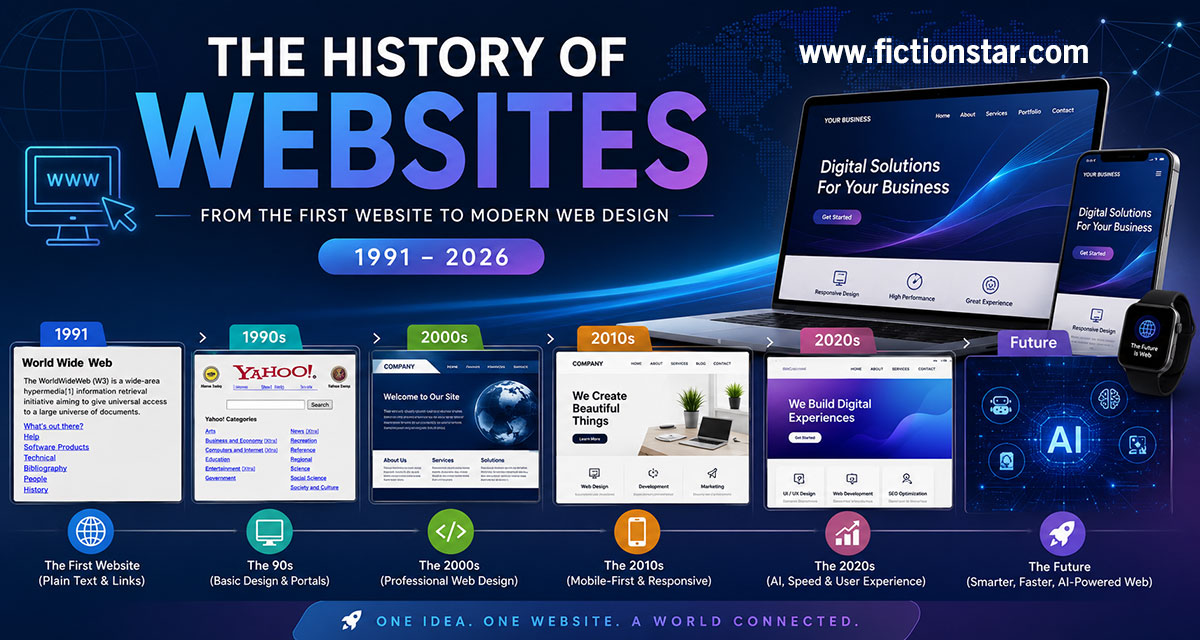
🌐 The History of Websites: From the First Website to Modern Web Design (1991–2026)
Imagine a world without websites, online shopping, social media, Google, YouTube, or even online business. Hard to imagine, right? 🤔
Today, websites power everything from small local businesses to global corporations. Whether you’re looking for a website designer in Indore, a website developer in India, or simply researching how the internet evolved, understanding the history of websites helps us appreciate how far technology has come.
In this article, we’ll take a fascinating journey through the evolution of websites—from the world’s very first website in 1991 to today’s AI-powered, mobile-friendly digital experiences.
🚀 The Beginning: Before Websites Existed
Before websites, sharing information online was extremely difficult. During the 1970s and 1980s, researchers relied on disconnected computer networks to exchange data.
There was no Google, no web browser, and certainly no modern website design. Information was stored in separate systems that were difficult to access and navigate.
The world needed a simpler way to connect information—and that innovation would soon change history forever.
👨💻 The Man Who Changed the Internet Forever
In 1989, British computer scientist Sir Tim Berners-Lee proposed a revolutionary idea while working at CERN.
His vision was simple:
- 🌐 Connect documents digitally
- 🔗 Allow users to navigate through links
- 📚 Make information accessible worldwide
- 💻 Create a universal information system
This invention became known as the World Wide Web (WWW).
Today, billions of websites exist because of this groundbreaking idea.
🌍 The World’s First Website (1991)
In August 1991, the first website in history went live.
Unlike today’s visually stunning websites, the first website was incredibly simple:
- ❌ No images
- ❌ No videos
- ❌ No animations
- ❌ No colors
- ✅ Pure text and hyperlinks
Its purpose was simply to explain what the World Wide Web was and how people could use it.
Little did anyone know that this basic page would launch a digital revolution that would transform business, communication, and society forever.
📅 Website Evolution Timeline
1991
🌐 First website goes live.
1993
🖥️ First popular web browser (Mosaic) introduced.
1995
🛒 Rise of commercial websites and online businesses.
1998
🔍 Google launched and changed internet search forever.
2004
📱 Social media era begins.
2007
📲 Smartphone revolution starts.
2015
📱 Mobile-first web design becomes essential.
2020+
🤖 AI-powered websites and automation emerge.
🎨 Websites in the 1990s: Simple but Revolutionary
During the early days of the internet, websites were basic collections of text and links.
Popular features included:
- 📄 Static HTML pages
- 🔗 Hyperlinks
- 📧 Email contact links
- 🖼️ Low-quality images
Despite their simplicity, these websites represented a massive leap forward in global communication.
🎨 The Rise of CSS and Better Design
As websites became more popular, designers needed more control over appearance and layout.
This led to the introduction of CSS (Cascading Style Sheets).
CSS transformed web design by enabling:
- 🎨 Better colors and branding
- 📐 Advanced layouts
- 🖋️ Improved typography
- ✨ Professional visual design
Modern website designers in India still rely heavily on CSS to create beautiful user experiences.
🛒 The E-Commerce Revolution
The late 1990s and early 2000s saw the emergence of e-commerce websites.
Businesses realized they could sell products online without physical stores.
This transformation changed industries worldwide and created entirely new business models.
- 🛍️ Online shopping
- 💳 Digital payments
- 🚚 Global product delivery
- 📈 Scalable business growth
Today, a professional website developer in India can build powerful e-commerce platforms that serve customers worldwide.
📱 The Mobile Revolution Changed Everything
When smartphones became mainstream, websites had to adapt.
People no longer browsed only on desktop computers.
This led to responsive web design—a technique that allows websites to automatically adjust to different screen sizes.
Today, mobile-friendly design is essential for:
- 📈 Better SEO rankings
- 👥 Higher user engagement
- 💰 Increased conversions
- ⚡ Improved user experience
🔍 Google and the SEO Era
As millions of websites appeared online, finding information became difficult.
Google solved this problem with powerful search algorithms.
This gave birth to Search Engine Optimization (SEO), helping businesses rank for keywords such as:
- website designer in Indore
- website developer in Indore
- website designer in India
- website development company
Today, SEO is one of the most important parts of website development.
🏢 How Websites Changed Business Forever
Websites transformed how companies operate.
- 🌎 Reach global customers
- 📞 Generate leads online
- 💬 Improve customer support
- 📊 Track marketing performance
- 🛒 Sell products 24/7
Modern businesses depend on websites for growth, credibility, and customer acquisition.
🤖 AI and the Future of Website Development
Artificial Intelligence is shaping the next generation of websites.
Future websites will feature:
- 🤖 AI chatbots
- 🎯 Personalized content
- 📈 Predictive analytics
- ⚡ Automated customer support
- 🧠 Smart user experiences
The future of web development will focus on creating faster, smarter, and more personalized digital experiences.
🚀 Why Every Business Needs a Modern Website Today
Whether you’re a startup, local shop, consultant, or large enterprise, a website is one of the most valuable assets your business can own.
- ✅ Builds credibility
- ✅ Generates leads
- ✅ Increases visibility
- ✅ Supports marketing campaigns
- ✅ Drives long-term growth
A professionally designed website helps businesses compete effectively in today’s digital economy.
🏁 Final Thoughts
From a simple text page in 1991 to today’s AI-powered digital platforms, websites have come a long way. The history of websites is a story of innovation, creativity, and technological progress.
As technology continues to evolve, websites will remain at the center of business, communication, and online experiences.
🌐 The internet started with one website. Today, it powers the world.